Plugin Capital Research, August 7, 2026
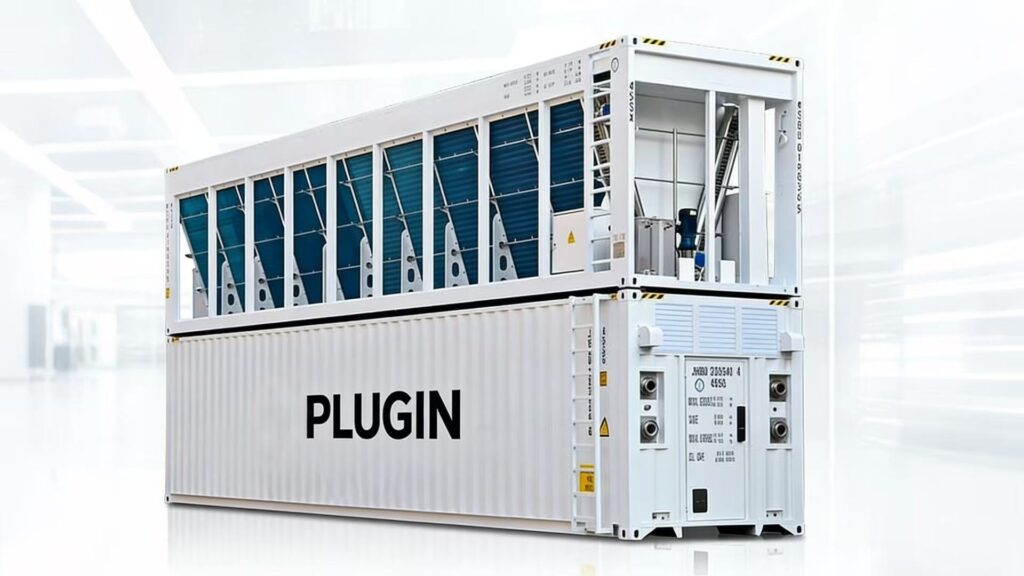
The question for AI infrastructure investors is no longer “Will modular containerized data centers win?” — they have won. The question is: who captures the value as the world’s most consequential infrastructure cycle unfolds in factory-built 20-foot boxes?
I. A New Kind of Bottleneck
For three years, the AI infrastructure conversation has been dominated by GPU scarcity. In the last 30 days, that conversation has changed. The bottleneck is no longer chips. It is power, permits, and — most acutely — delivery speed.
Consider what happened in the past month alone:
- Meta (Q2 2026 earnings, July 29) reported free cash flow down 91% year-over-year as $31.1B in capex swallowed operating cash flow, Future lease obligations rose 53% to $278.99B, with a single $68B DC leasing package signed in July.
- OpenAI (Wall Street Journal, July 26) is in talks for NVIDIA to backstop $250B of lease guarantees to anchor a 10 GW SoftBank mega-campus in Ohio, with Phase 1 alone costing an estimated $50B+.
- AMD–Anthropic (July 22) locked in a 2 GW Instinct MI450 commitment, with AMD co-investing up to $5B.
- AMD–Core Scientific (July 28) secured 2.5 GW of long-dated AI-ready capacity on 15-year leases.
- Anthropic’s $50B US DC program is being built by Fluidstack in 6 months per GW, using factory-prefabricated modules.
The capital is being deployed. The question is whether the physical infrastructure can be delivered fast enough to absorb it. Traditional data centers take 24–36 months to build. The chips inside them iterate in quarters. That mismatch is the strategic crack that modular containerized DCs were designed to fill — and over the past month, the data has shown that they are filling it at scale.
II. The Speed Gap, Quantified
Speed is not a marketing slogan. It is the dominant variable in the AI infrastructure return equation, and the past 30 days have produced an unusually clean set of benchmarks.
| Delivery Benchmark | Time | Source / Project |
| GW-scale, factory-prefab (Fluidstack) | 6 months | Anthropic $50B program |
| 60 MW IT load, factory-prefab (CIMC) | <10 months | Malaysia Johor “2312” |
| Single modular unit, AI-tuned (LG CNS AI Box) | 6 months per unit | Busan 50-unit campus |
| Standard modular pod (Duos Edge AI) | ~90 days | Hydra Host deployment |
| Portable/edge unit (Armada Triton) | 6 days | US Navy UNITAS exercise |
| 1,200-GPU inference pod (Runware Sonic) | ~3 weeks | US/EU rollout H2 2026 |
| Meta Ohio fabric-structure buildings | 9 months for 8 buildings | vs. 2–3 years for permanent builds |
| Traditional greenfield hyperscale DC | 24–36 months | Industry baseline |
Sources: Energy Vault official press release; CIMC official; LG CNS via Korea Times; Duos via IEEE Spectrum; Armada via Armada.ai blog; Runware official; SemiAnalysis 2026 modular report; Meta filings.
Read across the table: the time-to-power for a traditional hyperscale DC is 8–12× longer than the leading factory-prefab approaches. With AI hardware refresh cycles measured in 12–18 months, that gap directly determines whether a project generates ROI on the GPU generation it was designed for, or on the one two generations later.
SemiAnalysis’s 2026 modular deep report crystallizes the unit economics behind that speed: across AWS and Meta deployments, factory-prefabricated construction compresses schedule by 36%, reduces total cost by ~8%, cuts on-site labor by ~63% (to ~4,500 hours/MW), and reduces certified-electrician demand by ~85%.
Source: SemiAnalysis, July 2026.
That is not “incremental improvement.” It is a step change in the cost of capital for AI infrastructure.
III. The Capital Is Voting
If modular containerized DCs were merely a clever construction technique, this would be a niche story. They are not, and the capital flows of the last month demonstrate it conclusively.
Strategic capital is concentrating on the category.
- Fluidstack closed an $830M Series A at a $7.5B valuation (July, led by Situational Awareness, the AI fund backed by Stripe’s founders), in service of Anthropic’s $50B US buildout. Source: Shopifreaks / SiliconANGLE, July 2026.
- Armada closed a $230M Series B at a $2B valuation (co-led by Overmatch, 8090 Industries, and BlackRock, with Johnson Controls, NightDragon, Mitsui, and Singtel Innov8 participating), and announced a 400,000-sq-ft Arizona factory — Galleon Forge One — with Johnson Controls to manufacture its modular units. Source: Armada official, May/July 2026.
- Workhorse Group (NASDAQ: WKHS), a legacy EV manufacturer, announced entry into the containerized mobile-AI-DC market, targeting 2027 mass production from its Union City, Indiana plant. Source: SEC 8-K, July 28, 2026.
- Aether Holdings (NASDAQ: ATHR) launched the AetherPod VG100 via a strategic partnership with Virtual Grid, securing exclusive commercialization rights in Southeast Asia — the most direct competitive signal for projects in Malaysia, Indonesia, Thailand, and Vietnam. Source: TradingView / Newsfile, July 20, 2026.
Incumbent infrastructure capital is re-rating the asset class.
- BlackRock’s AIP, MGX, and GIP consortium closed the $40B acquisition of Aligned Data Centers on July 21, then immediately completed a $1.183B asset-backed securitization (ABS) on July 28, upsized by 30% from an initial $905M target because institutional demand exceeded supply. Over 90% of the collateralized rent comes from investment-grade tenants. Source: Aligned Data Centers official; Macquarie Asset Management announcement; Bruno.digital, July 28–29, 2026.
- KKR closed its $19.2B Global Infrastructure Investors V fund (August 3), its largest infrastructure fund ever, with over $9B already committed across nine investments including European DC operator Global Technical Realty. KKR’s global head of real assets, Raj Agrawal, made the telling observation: “Anything we can deliver in the next 2–4 years is being snapped up.” He added that KKR sees hundred-MW inference-focused, multi-tenant DCs as safer than 2–3 GW single-tenant training campuses, a quality-tiering call directly relevant to mid-sized modular projects. Source: Reuters / Moneycontrol, August 3, 2026.
- Galaxy Digital’s Helios II vehicle filed a $3.51B senior secured notes offering (July 22) for a 400 MW CoreWeave expansion, against a 15-year lease with $10.4B in minimum contracted payments. Source: Morningstar / Dow Jones, July 22, 2026.
- Cushman & Wakefield‘s APAC Data Centre Insights (July 2026) and Grand View Research both project the global modular / containerized DC market to more than double by 2030, with containerized DCs alone reaching $41B by 2031.
Hyperscaler capex is creating the demand pull.
The four largest US hyperscalers have spent ~$1.1T on AI capex since 2023 and plan to spend a further $745B in 2026 alone, a 77% year-on-year increase and 3× the 2024 level. The bottleneck has shifted from GPUs to power and the ability to build.
Sources: Financial Times / Bloomberg via The Agent Times, August 2, 2026; Goldman Sachs hyperscaler capex estimates; Morgan Stanley off-balance-sheet obligation estimates.
This is the demand that modular containerized DC is purpose-built to absorb. The next decade of AI infrastructure will be built in factories.
IV. Why It Is Now Imperative, Not Optional
Three structural forces are converging to make modular containerized DC the default delivery method rather than a niche alternative:
1. Speed has become a strategic moat.
When NVIDIA ships Vera Rubin at 90% lower inference cost per token, every quarter of delay in DC commissioning costs the operator roughly one full hardware generation of competitive position. The traditional 24–36 month build cycle is no longer just slow, it is strategically destructive. Fluidstack’s 6-month GW delivery, CIMC’s 10-month 60MW delivery, and Runware’s 3-week pod deployment are not merely “faster construction.” They are the difference between capturing and missing an AI capex window.
2. Factory economics now beat site economics at scale.
The SemiAnalysis data is unambiguous: factory pre-fabrication reduces schedule by 36% and cost by ~8% on the largest hyperscaler deployments, where the existing baseline is already highly optimized. The cost advantage is structural, not cyclical, driven by repeatable factory processes, robotics, supply-chain aggregation, and standardization. China’s prefab construction exports surged 45% year-on-year in H1 2026 to $2.79B, with data centers a key incremental driver, led by players such as CIMC (cumulative >1,000 MW delivered; pipeline >RMB 10B). Source: China Customs; Seetao, August 3, 2026.
3. Modular is the only architecture that flexes with power constraints.
The new bottleneck is electricity, not silicon. NextEra + Brookfield’s $100B Paducah AI campus (July 29) is a “bring-your-own-power” project. Energy Vault × Crusoe Spark (Snyder, Texas) integrates powered land, BESS, and modular DC in a single campus. The EU’s €30B AI Gigafactories tender, up to 7 sites, each ≥100,000 AI chips, explicitly emphasizes “energy efficiency and sustainability.” China’s “15th Five-Year Plan” dedicates an estimated RMB 4 trillion to compute network buildout, with hyperscaler capex (China Telecom) shifting to 35% compute infrastructure. Modular DC architectures, paired with BESS, microgrids, and closed-loop liquid cooling, are the only form factors that can be sited adjacent to constrained, intermittent, or stranded power sources. Source: U.S. DOE; Reuters; EU Commission; National Business Daily, August 6, 2026.
A fourth force is also worth flagging: modular is now a financing advantage. Aligned Data Centers’ July 2026 ABS priced into strong institutional demand at favorable rates; multiple sources indicate modular project financing rates in the 3.2% range vs. ~4.1% for traditional builds, a ~90 bp spread that directly improves project IRR and is itself a catalyst for further capital allocation. Source: Industry data via Seetao, August 2026.
V. The Risks We Are Watching
Cautious analysis requires flagging what could go wrong. Three risks deserve close attention:
1. Tenant credit concentration. Many of the largest 2026 DC projects are anchored to a single tenant — frequently OpenAI, Anthropic, CoreWeave, or one of the four US hyperscalers. NVIDIA’s 5-year CDS spread jumped 14 bps on July 28, the largest single-day move in that contract’s history, on concerns about the “circular financing” connecting GPU suppliers, model labs, and infrastructure investors. If the credit of a frontier-model tenant deteriorates, lease-backed project debt re-prices sharply. Source: 每经 via Tencent News, July 28, 2026.
2. Power scarcity, not capital, is the binding constraint. Goldman Sachs estimates hyperscaler capex could reach $7.6T by 2030, but the projects that get built will be the ones with secured power, not the ones with the best design. Modular helps, but it does not by itself solve the power problem.
3. Standardization risk. NVIDIA’s DSX platform (released March 2026) defines a “chip-to-building” reference architecture. Modular DC vendors must decide: align with DSX and accept ecosystem dependence, or pursue proprietary standards and risk customer pushback. This is a binary strategic choice, not a tactical one. Source: NVIDIA official press release, March 2026.
VI. Implications for Investors
For capital allocators evaluating the modular containerized DC opportunity, the past 30 days have clarified the investable surface area into a more legible shape:
- Quality is starting to differentiate price. KKR’s Agrawal is publicly calling out the gap between hundred-MW inference-grade multi-tenant assets and 2–3 GW single-tenant training campuses. The next 18 months will likely see an explicit pricing tier emerge.
- Geographic exclusivity is becoming a real moat. Aether Holdings’ Southeast Asia exclusive rights for the VG100 illustrate how US capital is now actively carving up regional deployment rights. Regional modular players — and the partners / competitors they pull in — need to act on geographic positioning now.
- Vertical integration is the second-order play. The most capitalized modular-DC names (Fluidstack, Armada, Crusoe, Vertiv) are increasingly bundling power procurement, BESS, and operational services. The pure “build the box” model is being squeezed.
- The infrastructure-financing layer is the largest, most durable opportunity. Aligned’s $1.183B ABS upsizing, Galaxy’s $3.51B notes, and the broader $5.5T hyperscaler capex pipeline through 2030 mean that the financing and securitization of AI infrastructure — not the construction itself — may be the highest-margin layer of the stack. Investors with origination capability in this layer are best positioned.
VII. Conclusion
The data over the past 30 days tells a coherent story. Modular containerized data centers have moved from innovation to imperative in the same window that AI capex moved from optional to existential for the world’s largest technology companies. The speed gap, the unit-economics gap, the power-flexibility gap, and the financing-rate gap all point in the same direction.
For the world’s biggest AI tenants, the question is no longer whether to build modular — it is how quickly modular supply can be brought online. For investors, the question is no longer whether modular will capture share — it is how to underwrite the builders, the operators, and the financiers who will capture the value as the largest infrastructure build-out of our generation moves from construction sites into factories.
The container is no longer the alternative. It is the default.
This article is published by Plugin Capital Research for general information and does not constitute investment advice. All figures, valuations, and projections reflect public-source reporting as of the publication date; forward-looking statements involve uncertainty. Past performance is not indicative of future results.